- IPO – Heart of Goldman Sachs
o Commitment to tech
o L-T market leadership in technology financing
o Success w/ IPO franchise
o #1 M&A advisor
- Rally in context
o Restored Confidence
o Fear of missing rally
o Moderation of Volatility
- Bull vs. Bear Case
o Bull
Government intervention working
Economic data points are positive
Corporate profit declines slowing
Fear of missing rally
Market is cheap
o Bear
Macroeconomic data remains bleak
Recovery slow – muted
Corporate profits decline continues
Intervention risk remains
Massive inflection
Rally lacks conviction
- What makes a good IPO?
o Formula – Characteristics
Management
Earnings
Sector
Cash-Flows
Growth
IPO Discount
Track Record
Conservative Financial Projections
o Components
Sector
Stage of Growth
Earnings Drivers
Management Track Record
Proper sized/structured transactions
o Early companies that IPO
“Need to be bigger”
Scale and Profitability
“Catalyst – Economic Stabilization - Market Easier to Access”
- Other Thoughts:
o Growth – out perform Value during rally
Technology is a big benefactor
Technology is up 35%
Investors moving into later-stage cyclical
IT Survey more positive – “Recession fatigue”
- Closing Thoughts
o IPO Market Open
o Investors Looking for new growth stories
o Supply/Demand favors issuers
- Panel – “The IPO – Lessons Learned from Senior Executives”
o Advice
Predictability
• Very good forecast – no positive or negative surprises
Maturity
• Space Shuttle – when you go for the IPO – don’t drop the booster rockets and fall back to earth!
No Doubt
• Go when you go – don’t get on file and wait for the right time
o How to best achieve
Maturity and Predictability
• Business model, expense
• CEO, CFO, Sales – good at hitting numbers
Not to do
• Wait too long to hire good public CFO and finance team
• Stop while started
• Blame the auditors
Cost of Compliance
• 404, SARBOX, Malpractice, Registration fees - $1-2m+
Board – need a great board
• Need operators – not just VCs
• Difficult to change board members
Choosing Underwriting Team
• Pick one horse
• Other firms may give you more research following
Road-show Process
• Grueling process - Childbirth
• Don’t know until the end
• 90 meetings in 2 weeks
• International is not that important
Public Market Pressure – Significant
• Little room for anything
• Don’t spend too much time with investors – cap at 5% of CEO time
• Hit your numbers
- Buy-side Comments
Charles Ellwein – Capital Research Global Investors
• Focus on public - $9b Small cap fund - $660B AUM
• When looking at a company
o CEO – is this someone I can trust, consistency
o Red Flag if they don’t know their business well enough
Ajay Diwan – Seligman Investments
• Cross-over investments (public and private)
Wednesday, May 13, 2009

Friday, May 8, 2009
Papa's Recent Picks

Papa – list of 20 names for long-term investment - still keeping in cash till next pullback - then:
- GLD
- DNA/AMGEN
- QQQQ
- AAPL/GOOG
- COSCO
- Midsize Growth
- Copper
- Homebuilder
- NTFLX
- Gilead Science
- TWGP
- Cal Water Service
- Stayer Education
- EADE
- EEM
- Commodity – Lumber
- BRINKS
- Akamai – infratech
- Comcast
Monday, May 4, 2009
Quarter-Life Crisis

http://www.eyeweekly.com/city/features/article/55882
This is something I have thought a ton about recently – some I have felt – and even more what I have seen or heard from friends trying to figure their own path out.
It is interesting to see how because of the close to infinite options we now get to consider at any moment – as compared to in the past where our parents or their parents were restricted to much more limited universes – you see people overwhelmed to the point of paralysis.
Social networks aren’t all evil – they connect us with other who we might normally not be – and reinforce the bonds of already established friends. The problem is that you end up connecting with too many people and that the ties to any individual relationships become weaker. There will be a backlash to the social network lifestyle that has emerged – and I think it will only get worse to those growing up with it from a young age.
The real problem this generation falls into with many girls and guys at this age is an unwillingness to figure out who they are and too much cynicism based on tremendous insecurities. Not willing to have real conversations, not willing to go against what is ‘cool’, and willing to let others treat them in ways that they are not proud of.
I got a great quote sent to me today – “Your Only Fear is Possibility.” Our generation is a great example of that in action (inaction…). There will always be opportunity costs – but making decisions and going for it is what it comes down to. My Grandfather said that he felt that both people he has met of my generation as well as privileged young adults don’t have that fire to make them want to succeed quite like his generation. You have to find it yourself.
“Being paralyzed by infinite possibilities. Even though I know what I'm doing now isn't what I ultimately want to do with my life, I find it hard to take the next step b/c it might not be the 'right' step. When you have everything at your fingertips, it’s terrifying to think you might choose the wrong option. I think what this article, and conversations with people like you remind me of is that any action is superior to inaction and it's ok to fail as long as you challenge yourself to keep learning and keep being excited about what is next.
I do think that the general discussion of what it means to be in your 20s overall is also worth studying. As you said, the timing of life stages are so different for our generation -- most people our age (myself the exception, clearly haha) won't even consider the idea of marriage b/c they search for independence, while at the same time relying on their parents for many things. I sometimes wonder if it's this inherent contradiction b/w quest for independence and realistic dependence that contributes to ongoing strife and lack of identity in the 20s.”(from a close friend)
(With regards to relationships), I’ve found myself close to the right place at the wrong time, the wrong place at the right time, and the wrong place at the wrong time. But so far – have not found myself at the right place at the right time yet. Marriage and kids is something I am very excited about. But just like you – I take it very seriously (unlike I think much of our generation will). I think the divorce rate will increase to 70% by the time we are older.
As far as jobs – I realized that I love starting things. I like having my opinions and ideas valued. A start up is the best place for that. If it is a financial exchange today – in 10 years it could be a water purification biotechnology process. I love learning and interacting with people – and this gives me the chance to do it. My Myers Briggs results were mixed INTP/INTJ which is a combination of an architect/mastermind personality. This works for me.
You will find the role you want – and you will be very successful throughout your life. One thing you have to remember – enjoy this whole process along the way.
When we went to NCAAs for UCLA in 2004 – our coach sat us down and told us to remember what it is like to practice the week before, remember the pre-final dinner banquet – take it all in. You can have your ring from the national championship – but what is really valuable is the experience and memories associated with it.
Most people’s first jobs could sometimes be considered a very negative experience if looked at them that way – but I don’t. I learned a ton from both my experiences from skill-sets to have and how not to do business.
Whatever you do – it will build you and your ability to do more down the road.
Sunday, January 20, 2008
Genetics, Data, Money and Gambling
Over the past couple weeks, I have been lucky enough to get some great reading done. Why Beautiful People Have More Daughters, Rigged, The Poker Face of Wall Street, Made to Stick, The Imperfect Heart, and Super Crunchers are the books I have been spending my time enjoying. "
Reading the book "Super Crunchers" - we learn about how regressions help companies make more accurate predictions about, for example, what a person might buy or prefer.
The book "Super Crunchers" made an example of predicting future wine prices based on a formula that accounted the number of rainy days in a growing season and other variables. The formula was very accurate. Some dating sites claim to have developed metrics about what a person might like in a mate based upon a set standard number of questions. Even if it's not what they think they would want. A lot of Web 2.0 sites are using regression data from consumer behavior to fine tune the site's services and offerings." - Highly recommended

An Invisible Heart is a play on words for the economic idea of the invisible hand that regulates the market. It is an endearing book that makes economics enjoyable and can help any lay person understand the major concepts, which make Economists stay in their fields. A well respected friend recommended it to me, and I am now recommending it to you.


Made to Stick was a follow up on Malcolm Gladwell's book the Tipping Point. The Tipping Point explains the Law of the Few (Connectors, Mavens and Salesmen), the Stickiness factor, and the power of context. Made to Stick explains the Stickiness factor. "The book's outline follows the acronym "SUCCES" (with the last s omitted). Each letter refers to a characteristic that can help make an idea "sticky":
* Simple — find the core of any idea
* Unexpected — grab people's attention by surprising them
* Concrete — make sure an idea can be grasped and remembered later
* Credibility — give an idea believability
* Emotion — help people see the importance of an idea
* Stories — empower people to use an idea through narrative
I would definitely recommend the book "Made to Stick" for any person who wants to understand how to make an idea be best presented to the world.

Rigged is Ben Mezrich's follow up to his widely popular "Bringing down the House" book. Described by Amazon as about a character who, "After conquering the hallowed halls of Harvard Business School, he enters the testosterone-laced warrens of the Merc Exchange, the asylumlike oil exchange located in lower Manhattan. A place where billions of dollars trade hands every week, the Merc is like a casino on crack, where former garbagemen become millionaires overnight and where fistfights break out on the trading floor.
This ordinary kid has traded Brooklyn for the gold-lined hotel palaces of Dubai. He keeps company on the decks of private yachts in Monte Carlo—teeming with half-naked girls flown in by Saudi sheiks—and makes deals in the dangerous back alleys of Beijing."
Unfortunately, Rigged falls way short of being necessary for the pages it was written on. It should have remained as a good journal article.

Why Beautiful People Have More Daughters is a great introduction to where Evolutionary Psychology has come in its short history. A mix between science, sociology, and econometrics. I enjoyed their "Savanna Principle" explanation, but unfortunately - the author's might use it to try to explain a little too much; from woman's lower pay to why sons reduce the chances of having a divorce.

The Pokerface of Wall Street was a let down after the 1st chapter. Aaron Brown does give some great comparisons to what wins in poker and trading. Most of it comes down to being about to identify opportunities, take and manage risk. Brown also throws off my interest on the non Texas Hold'em gambling examples.
Reading the book "Super Crunchers" - we learn about how regressions help companies make more accurate predictions about, for example, what a person might buy or prefer.
The book "Super Crunchers" made an example of predicting future wine prices based on a formula that accounted the number of rainy days in a growing season and other variables. The formula was very accurate. Some dating sites claim to have developed metrics about what a person might like in a mate based upon a set standard number of questions. Even if it's not what they think they would want. A lot of Web 2.0 sites are using regression data from consumer behavior to fine tune the site's services and offerings." - Highly recommended

An Invisible Heart is a play on words for the economic idea of the invisible hand that regulates the market. It is an endearing book that makes economics enjoyable and can help any lay person understand the major concepts, which make Economists stay in their fields. A well respected friend recommended it to me, and I am now recommending it to you.


Made to Stick was a follow up on Malcolm Gladwell's book the Tipping Point. The Tipping Point explains the Law of the Few (Connectors, Mavens and Salesmen), the Stickiness factor, and the power of context. Made to Stick explains the Stickiness factor. "The book's outline follows the acronym "SUCCES" (with the last s omitted). Each letter refers to a characteristic that can help make an idea "sticky":
* Simple — find the core of any idea
* Unexpected — grab people's attention by surprising them
* Concrete — make sure an idea can be grasped and remembered later
* Credibility — give an idea believability
* Emotion — help people see the importance of an idea
* Stories — empower people to use an idea through narrative
I would definitely recommend the book "Made to Stick" for any person who wants to understand how to make an idea be best presented to the world.

Rigged is Ben Mezrich's follow up to his widely popular "Bringing down the House" book. Described by Amazon as about a character who, "After conquering the hallowed halls of Harvard Business School, he enters the testosterone-laced warrens of the Merc Exchange, the asylumlike oil exchange located in lower Manhattan. A place where billions of dollars trade hands every week, the Merc is like a casino on crack, where former garbagemen become millionaires overnight and where fistfights break out on the trading floor.
This ordinary kid has traded Brooklyn for the gold-lined hotel palaces of Dubai. He keeps company on the decks of private yachts in Monte Carlo—teeming with half-naked girls flown in by Saudi sheiks—and makes deals in the dangerous back alleys of Beijing."
Unfortunately, Rigged falls way short of being necessary for the pages it was written on. It should have remained as a good journal article.

Why Beautiful People Have More Daughters is a great introduction to where Evolutionary Psychology has come in its short history. A mix between science, sociology, and econometrics. I enjoyed their "Savanna Principle" explanation, but unfortunately - the author's might use it to try to explain a little too much; from woman's lower pay to why sons reduce the chances of having a divorce.

The Pokerface of Wall Street was a let down after the 1st chapter. Aaron Brown does give some great comparisons to what wins in poker and trading. Most of it comes down to being about to identify opportunities, take and manage risk. Brown also throws off my interest on the non Texas Hold'em gambling examples.
Tuesday, December 18, 2007
Three Signs of a Miserable Job
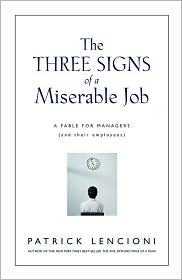
This book definitely could be taken as touchy feely. As a soft approach to management. As what managers should not waste their time with. Anytime spent on this crap is not focusing on the revenue growth or how it moves to the bottom line. Now maybe that is true, but in the services industry; restaurants, hotels, consultancies, auto-mechanics…anyone working with anyone else, other than revenue and profitability margins, customer service and satisfaction are directly or indirectly correlated to employee satisfaction and enjoyment with their job. “The dissatisfaction of employees has a direct impact on productivity, turnover, and morale, all of which eventually hit a company’s bottom line. What we learn is it’s not always about the money (or at least, just about the money).
Patrick Lencioni (the Author) proceeds to discuss how many CEO’s and professional athletes can feel the same sense of dread going to their jobs as a fry-cook or Tupperware salesman. People making millions of dollars a year can be miserable in their jobs, while some people who make little or no money can love what they do – like a volunteer or a high school volleyball coach. The author decides it is not a problem of ‘bad’ employees, that some jobs just aren’t as glamorous as others, or that if only a person made ‘x’ amount more an hour or a year- he’d be much more happy with his job.
Lencioni argues that instead, it is the manager’s job and responsibilities to not only motivate and train their employees, but to actually help them become aware of how they fit into the bigger picture. There is no reason the most adults who work over 8 hours a day at their jobs are dissatisfied. Patrick goes on to argue that the ‘Three Signs’ are Anonymity, Irrelevance, and Immeasurement. He feels that these three factors will make any job miserable, and it is the manager’s responsibility to help employees measure their contributions and find how what they do is relevant while also finding a way to be genuinely interested in their lives. People sometimes have some of one or two of these at their work but those truly happy with their jobs have a great balance and culture that addresses these issues.
Anonymity – People cannot be fulfilled in their work if they are not known. All human beings need to be understood and appreciated for their unique qualities by someone in a position of authority.
Irrelevance – Everyone needs to know their job matters, to someone. Without seeing a connection between the work and the satisfaction of another person or group of people, an employee simply will not find lasting or fulfillment.
Immeasurement – People need to be able to gauge their progress and level of contribution for themselves. They cannot be fulfilled in their work if their success depends on the opinions or whims of another person, no matter how benevolent the person may be. Without a tangible means for assessing success or failure, motivation eventually deteriorates as people see themselves as unable to control their own fate.
What is amazing about the problem and remedy that Lencioni describes is that it is effective and simple, but barely used. It seems obvious and ridiculously simple that most people might think that it doesn’t need to be said. Well it does. Everyone deserves to find fulfillment in their job and not spend their Sunday’s fretting over the upcoming week.
Thursday, December 6, 2007
Money and Banking - Subprime Crisis

Thanks to a good friend, I was able to sit in on a special guest lecturer, Kent Vickery from Carrington Capital, discussing the reasons, importance, causes, and predictions of the recent subprime situation. In Alex Gould's Econ 111: Money and Banking Course.
To preface the lecture - Alex discussed how 1. you don't want to be in a subprime mortgage - so keep the FICO score above 650 (a score between 720-850=99% chance to pay back) and 2. the psychological impact of the herd mentality. (They also compared the VC community to lemmings...another topic :) )
*for scale - in today's terms - the S&L Crisis would be $800B of losses
Kent's Points of Subprime:
1. Subprime Crisis is Nasty - $400 Bil of estimated losses
2. $300 Bil losses in US markets already
3. Ripple effect - A. US: property meltdown - 44.5M households will lose approximately $223Bil in wealth over 2008 and 2009
B. Globally - technical default after subprime resets
4. Disgruntled investors will be leading in litigation's to Investment Banks
5. History and How - went through 2/28 arm loans and just with a house of $675k house value and a loan of $417k, the difference in payments over 3 years between a conforming vs. a non-subprime borrower is $59,000 after taxes! At resets, price jump is too high and people cannot make their payments. "When things get tight, the BEAST must eat."
6. "Shadow Banking Bomb" CEO of PIMCO, anatomy of subprime CDO. People's ability to refinance/repay increases as their equity and value increases.
7. GSAMP Slide - Deutsche Bank Trust Reports: 12 Tranches, 10 investment grade
7/10 downgraded to junk, 4 have been wiped out. Cramer video - "no idea how bad it is", Idea: let market wash itself out, but election year so not politically possible. Goldman Sachs may have shorted the market when they saw the tranches slump.
8. Ripple turns into a tidal wave - like Enron crisis - or fall of LTCM
In banking "devil is in the details,"
Interesting idea from Ben Stein - investment banks (Goldman) center point for class-action lawsuit. Necessary information for litigation: EMAIL TRAFFIC: b/t Goldman and Deutsche Bank, outside underwriters, and credit agencies. They had default information and were still selling CDOs - so they made money on the shorts...shady.
Alex ended the final class with four points:
1. Cherish your relationships
2. Options are valuable
3. Trust your gut
4. Go out and get it
The worst thing that could happen to you; too rich, too beautiful, and peak too soon.
He then ended with a great speech. Anna Quindlen's commencement address to Villanova University, Friday 23 June 2000.
Monday, November 12, 2007
Copycats

In economics - when there is an excess profit in a market - companies will enter the market until the supply increases to a point, which lowers the price of the product and eats away at the profit. This idea holds true in all(most I can think of) marketplaces; recently - lemonade stands, airlines, restaurants, and recently technology startups.
"Can You Clone Tangler For $1,500?" is the headline of a Techcrunch article today.
"Someone in Turkey is willing to pay up to $1,500 to anyone who can “clone Tangler.” But don’t go too far - the listing also states “do not steal tangler.com images and do not violate copyrights. The clone should have the same functions, but the design should look different.”
A company that offers this is http://www.getafreelancer.com/. It is hard to imagine getting the best quality in just two weeks for <$1,500 to try to mimic some of the top web 2.0 technology site out there.
We'll see how this goes...
Subscribe to:
Posts (Atom)